Drinian
The Silver ChairDrinian is an older courtier whose judgment and loyalty shape the tragedy surrounding Prince Rilian’s disappearance. A trusted friend to both Rilian and King Caspian, he witnesses the prince’s encounter with a mysterious green woman, recognizes that something is wrong, and then fails to warn the king. When Rilian vanishes, Drinian accepts blame and expects punishment; Caspian instead forgives him, preserving their friendship amid shared grief.
Identity and Background
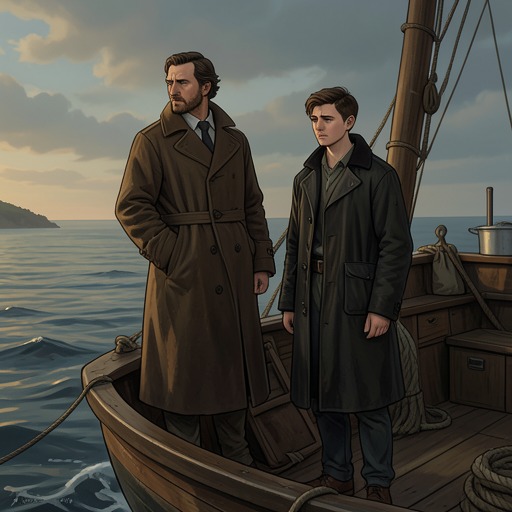
Among the older courtiers, Drinian is Rilian’s chief friend. He also has a longstanding bond with Caspian: he had served as captain on the king’s great voyage to the eastern parts of the world. The narrative thus places him between generations, close to the missing prince while connected by earlier service and friendship to the grieving king.
Drinian’s position brings him into the events not as an investigator appointed to search for Rilian, but as someone who personally sees a warning sign and must decide whether to report it. His actions and later confession give the prince’s disappearance a human consequence beyond the loss itself: the silence of a trusted companion becomes a source of guilt and a test of friendship.
Rilian’s Grief and the Northern Woods
After the death of his mother, Rilian repeatedly rides in the northern marches, apparently seeking the venomous worm that killed her. The prince’s grief is intense, and his solitary rides eventually acquire a different purpose. When Drinian urges him to abandon an exhausting search for vengeance against an unthinking creature, Rilian says he has nearly forgotten the worm and explains that he has seen the most beautiful thing ever made.
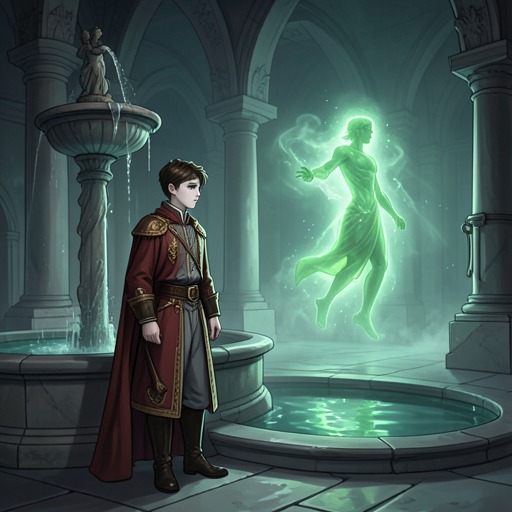
The answer prompts Drinian to ask to accompany him. The following day, they ride at speed into the northern woods and stop at the same fountain where Rilian’s mother died. At noon, Drinian sees a tall, shining lady at the fountain, dressed in a thin garment as green as poison. She beckons to Rilian without speaking. The prince stares at her as if out of his wits, and then she disappears. Drinian finds the encounter troubling: he suspects that the radiant green woman is evil, despite the beauty that has captivated Rilian.
Silence and Rilian’s Disappearance
Drinian wonders whether he should tell Caspian what happened, but hesitates because he does not want to become a tale-bearer. He holds his tongue. The next day Rilian rides out alone; that night he does not return. From that hour, no trace of him is found in Narnia or any neighboring land, and his horse, hat, cloak, and other belongings are never recovered.
The sequence makes Drinian’s silence consequential. He had observed the woman’s summons and distrusted her, but did not share what he knew before Rilian went out alone. Once the prince is missing, Drinian interprets that omission as a betrayal that helped destroy Caspian’s son. His admission reflects the burden of hindsight: he cannot know that speaking would certainly have prevented the disappearance, but he believes his failure to speak has made him responsible.
Confession, Grief, and Forgiveness
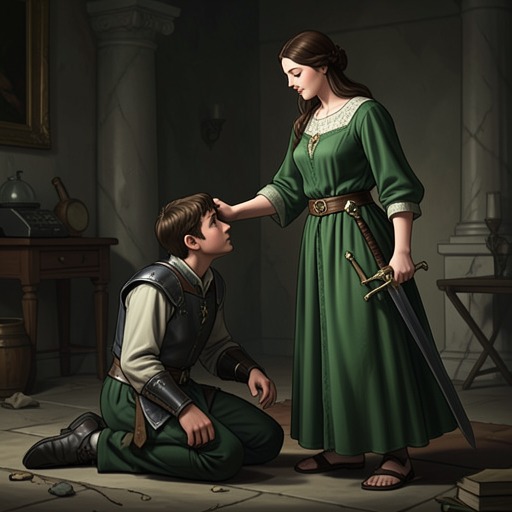
In anguish, Drinian goes to Caspian and asks the king to kill him as a traitor. He explains the encounter at the fountain and his decision to remain silent. Caspian reacts with fury, seizing a battle-axe and rushing at him. Drinian stands still, prepared to receive the blow; the narrative presents his willingness to face the king’s anger as a direct consequence of the guilt he has confessed.
Caspian stops before striking. Having lost both his queen and his son, he refuses to lose his friend as well: he throws away the axe, embraces Drinian, and weeps with him. Their friendship survives the revelation. The moment does not undo Drinian’s silence or Rilian’s disappearance; instead, it turns the expected punishment into a painful act of reconciliation between two men already joined by grief.
Narrative Role
Drinian’s part in the account links the prince’s private fascination with the green woman to the public mystery of his disappearance. His firsthand sighting establishes that the woman appeared at the very fountain associated with the queen’s death, while his suspicions make the danger visible before Rilian vanishes. Yet the warning is not passed on in time, leaving the event shadowed by the question of what might have changed had Drinian spoken.
His confession also gives the episode its emotional resolution. Where the disappearance separates Caspian from his son, the king’s decision to spare and embrace Drinian prevents grief from destroying another relationship. Drinian remains associated with a failure of judgment, but the ending defines his bond with Caspian through candor, shared mourning, and forgiveness rather than punishment.